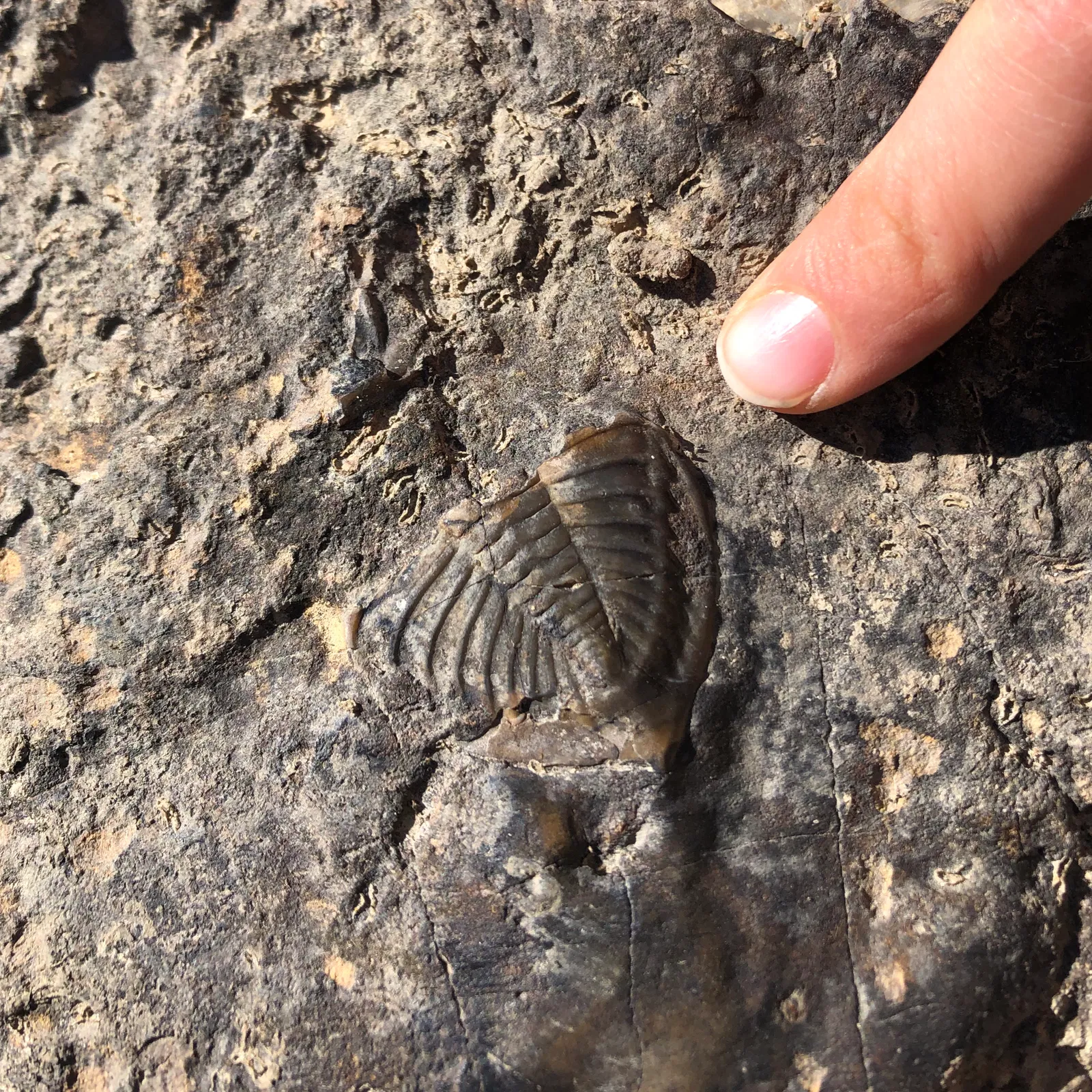
Today I would like to share something from the three incredible SIU undergraduate students who came as special guests during our Farming & Gardening block in February! They led a wonderful lesson where the children began to look at the actual land they were standing on when we were standing in my yard. I plan to have a continuing partnership with them where they will lead Environmental Education lessons, helping the students develop a sense of place and connect with where they live... in multiple contexts over a period of time. This is also called Place-Based Education.
Sienna Walaszek was chosen to be one of only nine speakers at TEDxSIUC on January 5, 2020. Her talk was titled "Connecting to Our Inner Child" and you can watch it here. She is a junior Philosophy major.
Grant Depoy and Jacob Bolton were chosen to be two of just seven 2019-20 SIU University Innovation Fellows as part of the Center of Innovation, located at One Innovation Place, 1745 Innovation Drive in the SIU Research Park. Grant is a senior Forestry and Hydrology major. Jacob is a senior Forestry major.
Together these three up-and-coming SIU student innovators / philosophers / entrepreneurs have formed a group called the "Department of All Beings."
Their mission statement reads, "The Department of All Beings role in global sustainable development is to facilitate programs and resources for local communities to co-create an environment of holistic learning and socioecological resiliency which consciously preserves the integrity of all beings.“
Their current focus is on creating children’s programs and outdoor laboratories / natural playscapes, and so I asked them to share some ideas for our families who want to do Outdoor Education in their yards. They write:
Growing Memories in the Yards of Our Global Neighborhood
Warm greetings from Southern Illinois! Our names are Sienna Walaszek, Grant Depoy, and Jacob Bolton! We are students at Southern Illinois University - Carbondale and grateful supporters of our community's beautiful, diverse ecosystem. The current COVID-19 pandemic has presented us with the realities of a global-scale social and ecological disturbance, and in opposition to sitting idly, we wanted to offer some perspectives and tools to make use of for the caretakers of children, and really anyone else who wants to use their freed-up time to become deeper connected with the earth!
As trained environmental educators, we see that our role is crucial in framing obstacles and unexpected disturbances as opportunities for growth - either within ourselves, in our relationships with others, or in our relationships with the natural world. What opportunities for growth might have arisen from the presence of “social” or “physical” distancing in the lives of our children, whose innate quality of playful and social learning has been challenged by the confinements of home-life? What safe environments can parents and guardians facilitate for their children to learn freely and happily, without exhausting anyone’s emotional or physical reserves? Luckily for many families, a back or front yard, a small park, or garden area aren’t too far from home - and all provide perhaps one of the most suitable settings for ease-of-learning.
Enjoying time outdoors can supplement your child's formal education. With a pinch of patience, and with a willingness to be outside, anyone can act as an environmental educator, opening them and their children up to the diverse relationships between them and their surroundings. With the tools which mother nature equipped us, such as our creative imaginations and our senses, we can experience these relationships in any number of ways, facilitating neural connections and making memories. Smelling the sweetness of Spring’s flowers and sprouting leaves reminds us of the pollinators busy at action, the direction of the wind gently pulling the scents about, and offers a foreshadowing to the berries that we can later taste in the summer. Looking closely at leaves reveals small hairs that might be long and silky or matted and shaggy, or stepping back and looking from afar reveals their shapes, patterns, and colors. To which trees and shrubs do these leaves belong? What creatures like to hang around these plants and why?
Our animal senses gift us with some of the most accessible educational experiences. Intentional mindfulness and open observation brings about a new appreciation of the myriad of sensations permeating us in each moment, and these experiences offer opportunities to understand deep concepts embedded within the natural processes. All we have to do is keep asking questions with a genuine curiosity! Pairing our senses with the miracle of human imagination ensures that even the smallest of green spaces will yield infinite learning opportunities. Thankfully the imagination and roleplaying abilities of our children thrive when given a little encouragement. Next to our natural imagination and observation skills, there are tons of step-by-step activities (see below) to explore - some of which contribute directly to sustainability, like tree planting and gardening (please contact us for more tips on these!).
Research and Benefits
In a study by Ryan et al. 2010 "Vitalizing Effects of Being Outdoors and in Nature", the authors define vitality as "having physical and mental energy." Spending time in natural conditions is shown to raise our vitality and vigor! "Vitality represents energy that one can harness and use for purposive actions" (Ryan et al. 2010) such as self-cultivation and learning!
-
Ryan, Richard M., et al. "Vitalizing effects of being outdoors and in nature." Journal of Environmental Psychology 30.2 (2010): 159-168.
In this study, Forest Schools in Europe provide regular interaction for school children with their environment. "Improvements in the children's confidence, motivation and concentration, language and communication and physical skills were recorded by teachers in Forest Schools."
-
O'Brien, Liz. "Learning outdoors: the Forest School approach." Education 3–13 37.1 (2009): 45-60.
Here are 8 super-fun outdoor activities to try today!
Activity 1: Identifying Our Surroundings

Activity 2: Planting a Family Tree
Activity 3: Garden Projects and Crafts
Activity 4: Recycled Bird Feeder
Activity 5: Listening Walk
Activity 6: Backyard Fun
Activity 7: Nature Scavenger Hunt with Sensory Card
Activity 8: Exploring Our Sense of Taste




 Immersive Experience
 Immersive Experience
 Immersive Experience
 Immersive Experience


