The original text (1924) is available online for FREE at Project Gutenberg, but there have been subsequent revisions.
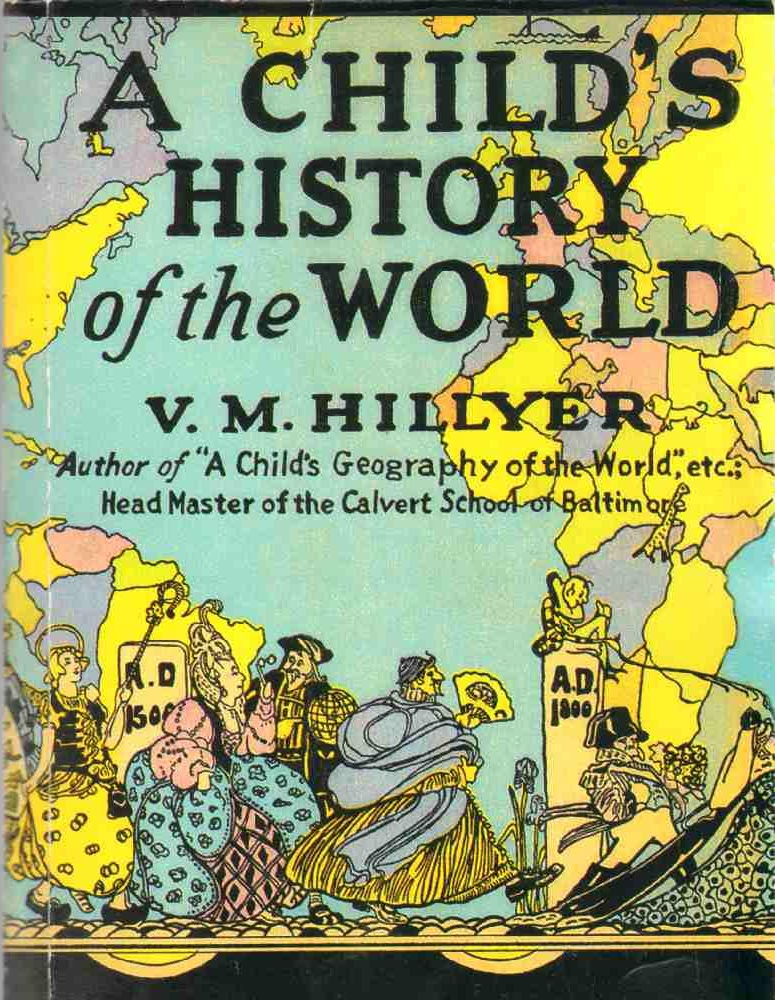
https://www.gutenberg.org/cache/epub/67149/pg67149-images.html
Please know that the original is a problematic text due to its age. While it is still my top choice for this block -- as it moves at the speed needed to cover so much information so quickly, and is cheerful, lively, and easy to read (and was my absolute favorite book as a child) -- please be prepared.
The original version of A Child's History of the World is very racially biased as well as being overtly slanted toward Christianity, as would be expected for the time in which it was written. Later revisions have sought to rectify this. If you are using an older edition, feel free to revise and retell portions of the chapters in language that is more suitable for our current time.
The other books we used in her block were
- The Corinthian Girl by Christina Balit
Bible (Daniel 5)
The Spartan Twins by Lucy Fitch Perkins
The Death of Socrates by Jean Paul Mongin
MLB Ideas - Time Travel Scrapbook
I think that a Time Travel Scrapbook would be a good theme! As if the child went back in time and visited those people and places, is taking notes on everything she saw and heard, and glued in a few mementos along the way.
Week One, Day One
chap 10 Fairy-Tale Gods
chap 11 A Fairy-Tale War
-
For this day, chapter 10 is more of a review, so her summary will probably focus on chapter 11. I would draw the Golden Apple... or the huge serpents crawling out of the sea... or the tall stone walls of Troy with a big hole torn in them so that the horse would fit in.
Week One, Day Two
chap 12 The Kings of the Jews
chap 13 The People Who Made Our ABCs
-
This is more background knowledge so that she knows what is happening in other parts of the Mediterranean. And to introduce the Phoenicians, who will come up later on in the Punic Wars.
I would draw the chip of wood which contained the message for Cadmus's wife. If you want to have some real fun, you can cut it out of brown construction paper to look like wood, and then glue it in. You could also use the actual Phoenician alphabet. https://crewsproject.wordpress.com/wp-content/uploads/2017/05/writing-your-name-phoenician.pdf
Alternatively, you could draw the little snail from which they got the purple dye, or a swatch of the color itself (maybe you happen to have a scrap of fabric that is the right color?), or the huge kettles with fires under them lining the shore of the sea.
(To make Tyrian purple, marine snails were collected by the thousands. They were then boiled for days in giant lead vats, producing a terrible odor.) https://vimeo.com/70961446
Week One, Day Three
chap 14 Hard as Nails
chap 15 The Crown of Leaves
-
The Laconic letter that contains only one word -- IF! -- would be really fun to write. She could then fold it and and put it in an envelope, and glue the envelope into the main lesson book (with the back of the envelope facing outwards, so that people could still remove the letter and read it).
Week One, Day Four
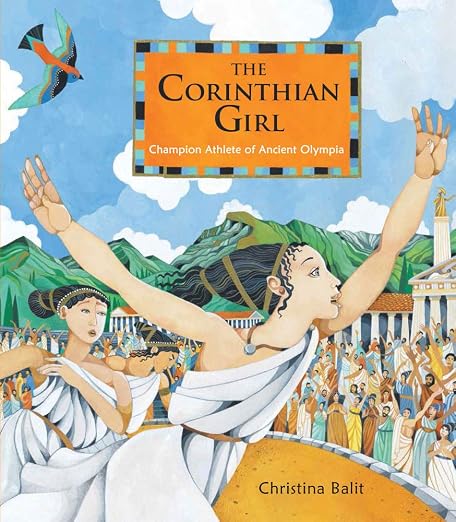
The Corinthian Girl by Christina Balit
-
Drawing a crown of laurel leaves would be your best bet here, unless you want it to be a swaddled baby who was left at the marketplace.
This is the companion PDF to the book, which has more ideas for follow up activities. https://www.otterbarrybooks.com/_files/ugd/f41f83_05145e5d39b548e5b9eac8964f9c4125.pdf
Week Two, Day One
chap 16 A Bad Beginning
song from Seven Brides for Seven Brothers ("Sobbin' Women")
-
I think it would be fine to print a picture of the famous statue of Romulus and Remus with the wolf, and add it to your "scrapbook." We have one from an old encyclopedia we made into a book box.

You can decide if you only want her to watch the clip of the "Sobbin' Women" song from Seven Brides for Seven Brothers, or watch the entire film. It is one of our favorites! https://amzn.to/44bQznQ
Week Two, Day Two
chap 17 Kings with Corkscrew Curls
chap 18 A City of Wonders and Wickedness
-
Once again we take a detour to Greece and Rome's neighbors, so that she can see a slice of "horizontal history" and what else was going on at the same time.
You could draw a stack of cuneiform clay tablets in the first public library (I love that the bookshelves are still called 'stacks' today for this reason). Or write out the name of Nebuchadnezzar (page 61 from Hillyer) in cuneiform writing... or draw the luxurious Hanging Gardens planted on the sides of a hill built on the top of a house!
Week Two, Day Three
chap 19 A Surprise Party
-
Yesterday we were recalling grade 5 Ancient Mesopotamia... today we are recalling grade 5 Ancient Persia AND grade 3 Old Testament Stories, and slotting both of those into their place in actual History. This is the story of Daniel in the Lion's Den. If you have a picture book for that (we use The Story of Daniel in the Lion's Den retold by Michael McCarthy but I am sure there are lots of other options), you could look in it for illustration ideas. Of course you could read that section from the Bible, if you have one handy.
https://www.kingjamesbibleonline.org/Daniel-Chapter-5/
I think a hand writing on the wall with letters of flame could be really cool! MENE, MENE, TEKEL, UPHARSIN
You could, of course, also go with the first coins instead (lumps of gold with Croesus' seal stamped in them). If you wanted to, you could cut out lumpy circles from gold paper and glue them in. I think the more things that are cut out from other materials and then glued in, the more scrapbook-y it will look.
Week Two, Day Four
chap 21 Rich Man, Poor Man
chap 22 Rome Kicks Out Her Kings
-
I would draw the voting box with some pieces of broken clay pot beside it (again, you could cut these out of terra cotta construction paper and glue them on).
Week Three, Day One
chap 23 Greece vs. Persia
chap 24 Fighting Mad
-
You could draw a big empty field and just put a signpost in it that says "The Plains of Marathon). And have another signpost nearby that says "Athens, 26.2 miles" with an arrow. That way she will be likely to remember that Marathon was a place, and that the distance between it and the Athenian marketplace is where we get the distance that people run today (for fun!).
Alternatively, you could draw the ballot box again with Aristides being ostracized. It actually changed history when that happened, because it meant that Themistocles got his way, was put in charge of Athens, and forced the Athenians to build a navy.
Although it's very funny that Xerxes had the water of the Hellespont whipped for destroying the bridge he was trying to build, it probably would be too hard to draw!
Week Three, Day Two
chap 25 One Against a Thousand
-
Here we see the connection with our Landforms & Water Features vocabulary! You could glue in any of your nomenclature cards that might be useful.
I think for this story, it also would make sense to draw a map (bird's eye view). We usually act it out first with blocks and silks and peg dolls. You can have the mountains on one side, the water on the other, and the narrow little pass. Then the two long lines of Persian soldiers stretching way out and off the page, and the small group of 300 men holding the pass (just draw them all as dots). The pass is important strategically because the Persian army has to come in small groups through that narrow entryway. It doesn't matter how many millions of soldiers there are when they are all forced to be funneled through that bottleneck. A small number is very fight-able.
Then you can draw a dashed line showing a secret way through the mountains. Of course, when the traitor gives that away, the army is able to trek through and get on both sides of the brave Spartans. Then they do not survive. Having to draw this out will really help her to understand what happened at the Bay of Salamis.
Week Three, Day Three
chap 26 The Golden Age
chap 27 When Greek Meets Greek
-
I think it would be fine to print a picture of the Parthenon and put that in. If you happen to have a postcard, that would be even better!
Week Three, Day Four

chapter 1 of The Spartan Twins by Lucy Fitch Perkins
-
I don't think you need to add anything to the MLB today. It's a chance to take a break and enjoy some historic fiction. My hope is that she will be pulled into the book and want to finish it on her own over the weekend! This story references the Battle of Salamis, and the Acropolis, and takes place while the Parthenon is being built.
Week Four, Day One

The Death of Socrates by Jean Paul Mongin (from Plato & Co. series)
demonstrate how to make a Bio-Cube for Socrates
have her choose a historical figure for her own Bio-Cube report
-
You could have a second day where she doesn't have to add to the MLB -- and can instead choose her biographical figure and collect her resources for her research -- or you can have her write about Socrates and draw the cup of hemlock. You could also print out a picture of an Ancient Greek cup and glue that in instead.
Week Four, Day Two
chap 28 Wise Men and Otherwise
chap 29 A Boy King
-
When I was a child, I absolutely loved the story of Demosthenes trying to speak above the roaring waves. She could just draw the seashore, or even the pebbles he put in his mouth. (Collage them out of sparkly paper?)
The horse's shadow could be another interesting thing to add. This is something she could trace on black paper if you had a wooden horse figure (put it behind a lamp and have it throw a shadow on the wall).
OR.... the Gordian Knot!
Week Four, Day Three
chap 30 Picking a Fight
chap 31 The Boot Kicks and Stamps
-
It would be simple for this story to draw the big hook that the Romans used to pull the Carthaginian boats close.
Or, you could make a map of Italy using tracing paper and draw the imposing line of mountains across the top of it.
Or...
This was my favorite book as a child, so I have lots of very strong associations with these stories. One part that stuck in my head for my entire life was how the Romans burned Carthage to the ground and then ALSO sowed all the fields with salt so that the soil would become barren. That way no city could ever spring up again in that same place. There would be no way for them to grow crops to feed themselves! It was such a powerful image to me. I think if I were a child, I would want to glue in some packets of salt (you can get these at restaurants, or make your own out of folded paper) and write something on them like "City Prevention Powder."
Week Four, Day Four
chap 32 The New Champion of the World
chap 33 The Noblest Roman of Them All
-
Rome is most famous for its technology. Consider a diagram of a Roman road (from the side, showing the layers) or drawing of an aqueduct. Some of these are still in use today!
https://www.nytimes.com/2024/04/24/travel/rome-ancient-aqueducts.html
Week Five, Day One
chap 34 An Emperor Who Was Made a God
chap 35 “Thine is the Kingdom, the Power, and the Glory”
-
It is nowadays thought that Cleopatra might have used a poisoned hair comb, so you could draw a snake alongside a poisoned hair comb if the part about Cleopatra is her favorite. If she is most interested in putting the life and death of Jesus in its historical place, she could draw the cross.
I think this block is particularly useful in the way that it brings together many different strands of things that children have heard about (like Zoroastrianism, Cleopatra, Mt. Vesuvius) and puts them all together in the same context.
Week Five, Day Two
chap 36 Blood and Thunder
chap 37 A Good Emperor and a Bad Son
-
Eruption of Mt. Vesuvius would be a simple thing to draw. It would be very effective to do it on black paper and use water soluble oil pastels or something else that is thick and creamy. That way the erupting lava would be against a dark sky, as the smoke and ash filled the air.
You could also consider having her write out a page from Marcus Aurelius's book of meditations and glue that in. Here are a few of the most famous: https://fourminutebooks.com/marcus-aurelius-quotes/
Week Five, Day Three
chap 38 I — H — — S — — — — V — — — — —
chap 39 Our Tough Ancestors
-
The easiest thing here would be Constantine's dream of the flaming cross in the sky, with the words below it “In hoc signo vinces.”
For some extra fun, you could listen to the They Might Be Giants song! This city is no longer called Constantinople; it is now called Istanbul. Find it on a map.
Week Five, Day Four
chap 40 White Toughs and Yellow Toughs Meet the Champions of the World
chap 41 Nightfall
give Bio-Cube report presentations!
-
You don't have to add anything to the MLB here really, except when the Fall of Rome happened. These chapters serve as a bridge to the Middle Ages block, the third and final history block for grade 6.
Fall of the Western Roman Empire - 476
capital city: Rome
Fall of the Eastern Roman Empire / Byzantine Empire - 1453
capital city: Constantinople
https://en.wikipedia.org/wiki/Byzantine_Empire
One last thought for the MLB:
-
You can decide if you'd like her to do a two page spread about the person who is the subject of her Bio-Cube report. This could fall somewhere in the middle, so that chronologically it is represented in the time in history when that person really lived.
Or it could be added as an Appendix. I did a MLB once with an Appendix and the children found the whole idea of it fascinating! We numbered the pages of it in the usual way, and in the Table of Contents put "Appendix: " at the bottom, with the title of whatever it was. We also looked at examples of books in the classroom that had appendices. I don't remember the block, but I remember that it was really interesting to the children, and it gave us a chance to talk some more about how nonfiction information can be organized.
This post contains affiliate links to materials I truly use for homeschooling. Qualifying purchases provide me with revenue. Thank you for your support!




 Immersive Experience
 Immersive Experience
 Immersive Experience
 Immersive Experience


No comments:
Post a Comment