Sunday, August 2, 2015

Resource List: Fables

In my first MLB with Leah, we get to do 10 stories (we are on a 2 day cycle).

I'm first going to gather all my resources for a Fables block; then I will choose the 10 stories and the extension activities.


I also have The Fox that Wanted Nine Golden Tails by Mary Knight, illustrated by Brigitte Bryan (1969), a book of Aesop's Fablespublished by Watermill Press, the Animal Legends 2nd grade Language Arts block book from Donna Simmons, as well as 2nd grade Live Education! books Teaching Fables, A Collection of Fables, and Drawing Simple Animal Forms.


Because this is a Cultural block, I would like her to have an orange MLB. Now I need to find the most economical supplier of Mercurius main lesson books. Any recommendations?

Friday, July 31, 2015

Nitrogen Cycle

I've shared before the link to the Nitrogen Cycle as a Felt Board Lesson, Montessori Style. This lesson is GREAT and I had so much fun making my felt board pieces! You can see some pictures of this lesson in progress at an exhibition of student work a few years back.


But I'm always looking for more resources to help students understand the relevance of Nitrogen and its cycle. I recently discovered a wonderful episode on Hulu Plus (requires a subscription) which is perfect. It is from a BBC Earth show called The Great Rift: Africa's Wild Heart.

The episode (Season 1, Episode 3) is simply called Grass.

Throughout this episode the narrator draws a lot of attention to Nitrogen. He explains the importance of Nitrogen to the living things of the area, and it made the relevance of this element crystal-clear, without being too pedantic. Highly recommended when studying Chemistry, Ecology, or Agriculture!


P.S. I just finished watching Episode 2 Water and it's actually about Plate Tectonics. Wonderful for Geology or World Geography: Africa!!!

Coffee Bean Crafts

Woke up this morning feeling very craft-y for some reason. First up, starting a houseplant from a pineapple top. Natalie and I tried this unsuccessfully last school year, but I think these instructions are better. Next, my husband gave me some extra coffee beans from local business Steam Shovel Coffee and I went looking for coffee bean crafts. LOVED the concept behind the sunflower wreath but I wanted something simpler so I went with the candleholder.

Finally, the baby has discovered his feet. He stares and stares at them but can't yet grab them. I want to sew him two simple felt ankle bracelets (strip of wool felt which fastens with snaps) with jingle bells on them. I have some bells leftover from Christmas crafts. To avoid a choking hazard, you would never put a child down and leave him/her unattended while wearing these.

Wednesday, July 29, 2015

Roasted Okra

I'm really starting to understand the phrase "Summer's Bounty." Adam went out fishing on Saturday and came home with 19 fish! So we used some fresh thyme, oregano, and parsley from the garden and had Whole Roasted Fish with Herbs. Wonderful!

His grandma brought us a bag of apples, which went into Caramelized Apple Slow Cooker Oatmeal. This is my new favorite breakfast recipe.

And a coworker is swapping veg with us, our spaghetti squash for her tomatoes. Adam brought home a big bag of tomatoes... and I picked our first okra from the garden yesterday (we have 8 happy healthy plants!). So I made spaghetti squash with Roasted Tomato Sauce and parmesan cheese. For the okra, which also cooks at 425, I cooked it in the oven alongside for the last 8-10 minutes.


Roasted Okra: Simply slice it crosswise to make little flowers, put in an oven safe dish, toss with olive oil and salt and pepper, and roast at 425 for 8-10 minutes. There's no slime at all and it's really yummy.


I've recently learned that you can freeze tomatoes whole and then thaw them later to use in sauces. What a great idea!


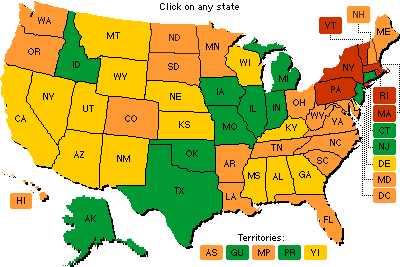
Yes, we are still getting organized for homeschool planning. Today we got the forms to register as homeschoolers. Every state is different, so check to see what's required where you live.


Our state is nice because public school access for homeschoolers is allowed in Illinois. That means that my oldest daughter doesn't have to go full time to public high school next year; we can pick and choose which subjects we want her to take and enroll her part-time. We will need to request this by May 1st of next year.

Friday, July 24, 2015

Chipmunk Repellant

It is beautiful right now in the garden, even with all of our planting mistakes (err... lessons learned), and the animals are enjoying it as much as we are! We recently watched a little chipmunk run off with a little green tomato in its mouth and when we went to investigate, sure enough it was one of ours. We know this because we only had 3. Now we have one. The same day I went to the garden and walked in and surprised a rabbit! So I researched rodent repellant and found a very handy tip for making a garlic spray.

Gardener to Gardener Almanac & Pest-Control Primer: A Month-By-Month Guide and Journal for Planning, Planting, and Tending Your Organic Gardenis full of practical tips from other gardeners. We are trying the garlic mash, an idea shared by Frank Daley of Menomonie WI. We will crush an entire head of garlic, put the mashed up garlic in a jug, fill it with water, and let it sit in the sun for several days to ferment. Then we will strain the potent liquid, put it in a spray bottle, and spray it around the perimeter of the garden in the evenings. He says to use it several nights in a row.


The garden has inspired a lot of cooking, and now that Zac is two months old (and 11 1/2 lbs and 24 inches long) he is taking longer naps, which means I can spend time cooking again.

Cucumber - I took the cucumbers which a friend gave us and used them in a Cucumber, Dill, and Orzo Salad.


Oregano - We used the fresh oregano from our garden in Creamy Tomato Soup. The amount of time it takes to cook, 45 minutes, is perfect for Roasting Garlic, which we spread on pieces of baguette.


Basil - We have used the fresh basil in our garden for a couple of things! Pasta Shells with No-Cook Tomato Sauce (a favorite in our house), Italian Tomato-and-Bread Salad, and, of course, Fresh Basil Pesto. In fact, we had spaghetti squash today for lunch with some pesto on top and the leftover tomato soup on the side.


These hot summer days have also inspired Brewed Sun Tea, which will go well with our fresh mint!


As we watch our garden, we can't help but marvel at the perfect pumpkin which hangs suspended from our fence. It is absolutely gorgeous, and 100% volunteer. In fact, the entire squash extravaganza which you see pictured below is 100% volunteer, consisting of a spaghetti squash and a pumpkin plant which both came up unexpectedly in the compost pile. And the perfect book to explain the idea of volunteer plants which take over your yard??? Too Many Pumpkins


Wednesday, July 22, 2015

Color Coding

I am a girl who loves color coding. I don't know why, but it works for me!

My daughters (6th and 8th grade) will be recording their individual work throughout the school day in black & white composition notebooks, called Plan Books. This is a method we learned from the last private school I taught at, which was a Montessori school. There, children planned their own day and recorded their lessons as they completed them. We will be more teacher directed with Waldorf, but as a homeschooler there is so much you do that counts as a lesson (for example, walking to hunt for morels = Nature walk / Science lesson) and it should all be written down.


How to Find and Identify Morel Mushrooms


I have yet to research how much the state of Illinois monitors their homeschoolers but, regardless, we would have documentation of student work. This includes my plan book, their plan books, and artifacts such as their main lesson books, portfolio of work samples, and photos and video recordings of lessons.

Our color coding is simple. Each day gets a page in the composition notebook. Write the date at the top and each work on a separate line. For older kids, they can write their start and stop times. In the margin, put a colored dot. Put a key to your colors in the inside front cover. This method also helps children to easily see if there's a subject they are doing too much or too little of.


Yellow - language
Orange - cultural (history & geography)
Red - fine arts (art & music)
Purple - practical life (knitting, woodworking, cooking, gardening, etc.)
Blue - math
Green - science
Brown - physical education
Gold - penmanship (and, in Waldorf, form drawing)
Silver - foreign language


I thought up the Gold for penmanship because I was thinking of illuminated manuscripts. In Montessori we introduce penmanship in the Fourth Great Lesson.

Silver is a new one for us, and I'm choosing to use it for foreign language because that is the KEY to experiencing foreign cultures. We are studying Latin (this is a really helpful page showing a complete comparison of introductory Latin programs) this year. I loved Latin in school and I am comfortable teaching it. It will help Natalie as she heads off to high school, plus it goes well with a study of Medieval Times.

We chose Latina Christiana.

Monday, July 20, 2015

New Plan Book

Getting excited about next school year!!!

This roomy flexible book will work well for multiple children & grades.