
The Number Bases page on my website gives a number of resources; here, I want to focus on the new Montessori-inspired Not-Golden Mats we made for the classroom! The original Golden Mat material looks like this:
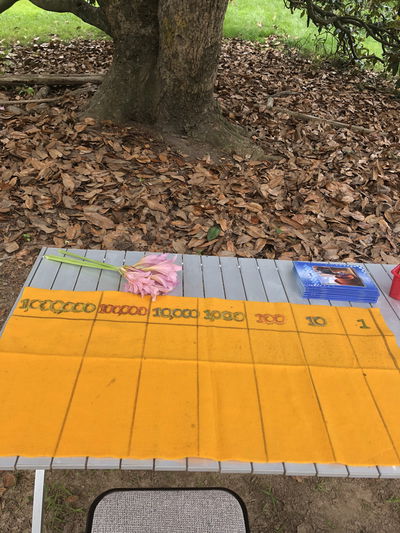
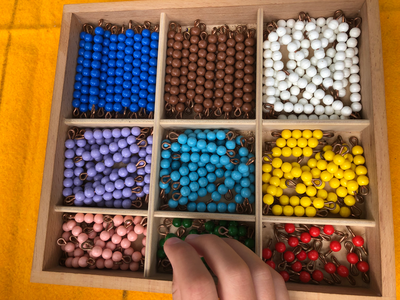
It is base-10, and it uses a set of Colored Bead Material that goes up to 9 (the highest possible digit in any place value).
With base-2, the mat would be green (the Montessori color coding for two). The only beads you would use would be the 1-bars. This is because 1 is the highest possible digit in any place value in the binary system. The place value headings across the top of the mat would also be different:
BINARY
n0 = 1
n1 = 2
n2 = 4
n3 = 8
n4 = 16
n5 = 32
n6 = 64
and so on, multiplying the value of the column by 2 each time
Figuring these out is a wonderful exercise for the childen, and we were very pleased with the resulting felt mat.


We also made an octal mat, which was super helpful for Jamie's Number Bases Practice Sheet #2 (PDF sample from Jamie's grade 8 workbook ).
Note: It works out really well for base-8 to read Weslandia by Paul Fleischman first!


For base-8, the mat would then logically be made of a dark brown felt, and we removed the extra bead bars from my Decanomial Bead Bar Box so that we didn't have anything higher than 7. Here are the place value headings:
-
OCTAL
n0 = 1
n1 = 8
n2 = 64
n3 = 512
n4 = 4,096
n5 = 32,768
n6 = 262,144


In my experience, it works best to use the Multi-Base Bead Frame when converting from decimal to the other number base (base-2 to base-16) and the Not-Golden Mats when converting from another number base to decimal.
For example, 37oct would be represented by a 3-bar in the 8s place and a 7-bar in the 1s place. 3 x 8 is 24, and 24 + 7 is 31dec.




 Immersive Experience
 Immersive Experience
 Immersive Experience
 Immersive Experience


No comments:
Post a Comment