I absolutely love John Cage...
and so I chose him as the focus of our first two Art Club sessions!

Beautiful Noise: The Music of John Cage
by Lisa Jean Rogers
In the past, we've often learned about John Cage in Philosophy:
-
Is It Music?
Jan 1, 2024
What Is Music?
Oct 12, 2016
My favorite quote ever from doing that lesson with children:
"That music lacked music."
If you're unfamiliar with 4'33" here is an NPR article:
-
The Story Of '4'33"'
https://www.npr.org/2000/05/08/1073885/4-33
A quote from this article:
- For the second, the provisionally entitled "Four Pieces," Tudor starts a stopwatch, sits down in front of the piano, closes the lid and begins a performance in which he never plays a note.
After 30 seconds of silence, Tudor resets the stopwatch and times another two minutes, 23 seconds of silence, then another one minute, 40 seconds of silence. But is it silence? ....
The silent composition, which became known by its duration of four minutes and 33 seconds, was influenced by Cage's encounter with the so-called "white paintings" by his friend Robert Rauschenberg — huge canvasses of undifferentiated white whose surfaces vary infinitely with particles of dust and light reflections.

Nothing: John Cage and 4'33"
by Nicholas Day
John Cage was in the news during COVID:
-
A 639-Year Concert, With No Intermission for Coronavirus
https://www.nytimes.com/2020/09/07/arts/music/john-cage-as-slow-as-possible-germany.html
The long, slow performance of a piece by the American composer John Cage is scheduled to run until 2640. On Saturday, an audience in Germany heard a sound change — the first since 2013.
John Cage has come up in our Art History studies of Sister Mary Corita Kent, Yves Klein, and Yoko Ono. His book with Lois Long, Mud Book: How to Make Pies and Cakes, is also featured in my list of Books in ALL CAPS.
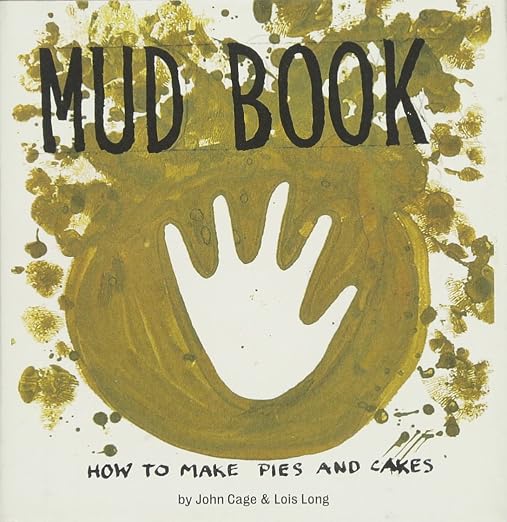
Mud Book: How to Make Pies and Cakes
by John Cage & Lois Long
We will also probably spend some time on John Cage when we do Inventors and the Slinky! In 1959, John Cage composed an avant garde work called "Sounds of Venice" scored for (among other things) a piano, a slab of marble and Venetian broom, a birdcage of canaries, and an amplified Slinky.
But on to my notes from Art Club:
Fri Sep 25 - introduction to mark making / graphic notation
read Beautiful Noise: The Music of John Cage by Lisa Jean Rogers
pass out large sheets of paper and colored pencils
make sounds and have the children create marks which go with them (shake water bottle, stamp feet, tap pencil, sweep broom)
look at examples of birdsongs in graphic notation
have each person sing one of the birdsongs
can we figure out which one they're singing?
have each person sing a wordless song of their choice
while we draw the colors & marks that go with their voice
set out a selection of musical instruments
demonstrate the sound made by each
have each person draw a set of colorful marks
then choose instruments and perform their "piece"
take a Nature walk and listen for birdsongs


Fri Oct 2 - tactile exploration / sensory play
read Nothing: John Cage and 4'33" by Nicholas Day
sit on a yoga mat in silence for 4 minutes and 33 seconds
what did you hear?
add drops of food coloring to water and watch it swirl around
read Mud Book: How to Make Pies and Cakes by John Cage
go outside to the mud kitchen to mix up recipes!
to the mud we added our colored water and some seashells


I did a whole blog post on Fun Things We Add to the Mud Kitchen. I find that colored water is such a simple addition and a surprisingly big hit with kids!
This post contains affiliate links to materials I truly use for homeschooling. Qualifying purchases provide me with revenue. Thank you for your support!



 Immersive Experience
 Immersive Experience
 Immersive Experience
 Immersive Experience


No comments:
Post a Comment