Wednesday, January 15, 2014

AWSNA Conference

I remember when I drove all the way up to the Sunbridge Institute, in Chestnut Ridge NY, to go to the Mid-Atlantic AWSNA Conference, only to find out that I actually live in the "Southestern" region. Oh, well. I still had fun.

Today I discovered that the annual AWSNA Southeastern Regional Conference is right near me this year, at the Baltimore Waldorf School!

The topic is "Core Values and Core Standards: Deciphering Mainstream Education Trends for the Waldorf Setting."

$50.00
March 14-15 (Friday evening and all day Saturday)
jchild@awsna.org for more information

Thursday, January 2, 2014

Waldorf High Schools

Gary Ward, from Island Oak High School, gave me some nice information about the Waldorf High School movement. He writes, "A couple of things about the high school. Rudolf Steiner did give quite a well-developed curriculum for grades 9-12, and evolved it over a couple of years. The Stockmeyer curriculum book “A Curriculum for Waldorf Schools” gives a lot of detail about Waldorf high school curricula. It is available at Rudolf Steiner College Bookstore, and at least one other place that I have seen, but forgotten. There is also a great lecture cycle on the high school age called “Education for Adolescents” (also called the Supplementary Course). It is available online in its entirety.

"You might want to also add Island Oak High School to the list of high schools. It is 16 years old, operating in Duncan, British Columbia, Canada. Island Oak and Sunrise Waldorf School are merging into one school after June 2013. Island Oak is one of the three complete Waldorf high schools in Canada."


Bibliography from Education for Adolescents:

  • Childs, Gilbert. Understanding Your Temperament! A Guide to the Four Temperaments. Sophia Books, London, 1995.
  • Elium, Jeanne & Don Elium. Raising a Daughter: Parents and the Awakening of a Healthy Woman. Celestial Arts, Berkeley, CA, 1994.
  • Elium, Jeanne & Don Elium. Raising a Son: Parents and the Making of a Healthy Man. Beyond Words, Hillsboro, OR, 1992.
  • Gabert, Erich. Educating the Adolescent: Discipline or Freedom. Anthroposophic Press, Hudson, NY, 1988.
  • Gardner, John Fentress. Education in Search of the Spirit: Essays on American Education. Anthroposophic Press, Hudson, NY, 1996.
  • Gatto, John Taylor. Dumbing Us Down: The Hidden Curriculum of Compulsory Schooling. New Society, Philadelphia, 1992.
  • Koepke, Hermann. On the Threshold of Adolescence: The Struggle for Independence in the Twelfth Year. Anthroposophic Press, Hudson, NY, 1992.
  • Large, Martin. Who’s Bringing Them Up? How to Break the T.V. Habit! Hawthorn Press, Stroud, UK, 1990.
  • Sleigh, Julian. Thirteen to Nineteen: Discovering the Light: Conversa- tions with Parents. Floris Books, Edinburgh, 1990.
  • Staley, Betty. Between Form and Freedom: A Practical Guide to the Teenage Years. Hawthorn Press, Stroud, UK, 1988.

I also am happy to share these documents from the Washington Waldorf School website.


List of Waldorf High Schools in North America

Chicago Waldorf School, Chicago, Illinois

Eugene Waldorf School, Eugene, Oregon

Green Meadow Waldorf School, Chestnut Ridge, New York

Hawthorne Valley School, Ghent, New York

High Mowing School, Wilton, New Hampshire

Highland Hall School, Northridge, California

International School of the Kootenays, Nelson, British Columbia

Island Oak High School, Duncan, British Columbia

Kimberton Waldorf School, Kimberton, Pennsylvania

Merriconeag Waldorf High School, Freeport, Maine

Rudolf Steiner High School, Ann Arbor, Michigan

Rudolf Steiner School, New York, New York

Sacramento Waldorf School, Fair Oaks, California

Seattle Waldorf High School, Seattle, Washington

Shining Mountain Waldorf School, Boulder, Colorado

Summerfield Waldorf School, Santa Rosa, California

Toronto Waldorf School, Thornhill, Ontario

Vancouver Waldorf School, N. Vancouver, British Columbia

Waldorf School of Garden City, Garden City, New York

Washington Waldorf School, Bethesda, Maryland


Please contact me if you have any additions or changes. Thank you!

Black and White Drawing in the Eleventh Class

I am not including high school resources on the website, so I'm going to just pop this link in here! This is to an article by Junemann and Weitmann called "Black and White Drawing in the Eleventh Class" (pdf) from the Waldorf Clearing House Newsletter Archive Fall 1984b issue.

See some example exercises at the Teaching Handwork blog.

Also, check out these amazing images of Glass Windows Designed by Rudolf Steiner.

Missing and New Resources

I'm working on updating and revitalizing the site (in response to multiple requests that I fix broken links -- which were completely justified) and will be moving some content from the main site to this blog to help streamline things.

One nice thing about doing this work is that I find new resources! One not-so-nice thing is that I find some things have disappeared.

For example, when I was looking for The Educational Tasks and Content of the Steiner Waldorf CurriculumI found that a new edition is about to be printed and will shortly be released, in Spring 2014! Preorder from Bob & Nancy's Bookshop in the U.S. or Floris Books in the U.K.

I couldn't find the AWSNA bookstore anywhere (have they closed it down?) but Floris Books carries AWSNA publications. However, they don't seem to have the old poster that was so helpful: "The Waldorf School Curriculum: An Overview for American Waldorf School Teachers."

It was wonderful for homeschoolers! Anyone know if this is still in print?

Update: Located at the AWSNA Bookstore which is still around!

Also, I was unable to find Roy Wilkinson's "The Curriculum of the Rudolf Steiner School" from 1919. Again, is this still around?

Update: Located at Bob & Nancy's Bookshop!

Thank you, Eva, for your help!

The Story of Written Language

The Five Montessori Great Lessons (and some include The Great River as a sixth) would make excellent Waldorf Main Lesson Blocks!

As a previous comment suggested, some Waldorf schools have chosen to the Fourth Great Lesson, The Story of Written Language, as a MLB. So, feel free to Google these main lessons for teaching ideas. Naturally, with the Waldorf method, they would NOT be done in 1st/2nd/3rd grade as they are in Montessori.

In Montessori, these lessons are done impressionistically, as an oral story told by the teacher over the course of several days. The teacher IS expected to memorize the story (sound familiar to anyone?) and artifacts to accompany the story are placed under a long silk and revealed in turn. Many teachers also dim the lights and light a candle. The students then engage in hands-on explorations to take the stories deeper. (Again, sound familiar???? When I became a Montessori teacher, these were the lessons I was most excited about teaching, because they are so Waldorf-y in so many ways, except for WHEN they are taught.)

Overview of the Five Great Lessons

Second Great Lesson full story and suggested artifacts for storytelling from NAMC teacher training (free sample lesson)

In short,
the First is How the Earth and Universe Came to Be
the Second is How Life Came to Be
the Third is How Humans Came to Be
the Fourth is How Written Language Came to Be
the Fifth is How Numbers Came to Be

The Great River is the story of how the systems inside the human body work together (a Waldorf 8th grade lesson).

Some of these have had books written about them by Montessori teachers, like


Some books you stumble across just happen to be a great fit, like


Miss Barbara's website is a common resource for the content of the stories themselves and Pinterest (believe it or not) is full of great ideas for follow up activities. You'll find things for these lessons everywhere you go... I was literally hiking the Stonefort Trail at Giant City State Park, IL yesterday and the trail guide was step-by-step the perfect Third Great Lesson!

Here's The History of Writing from Miss Barbara's site.

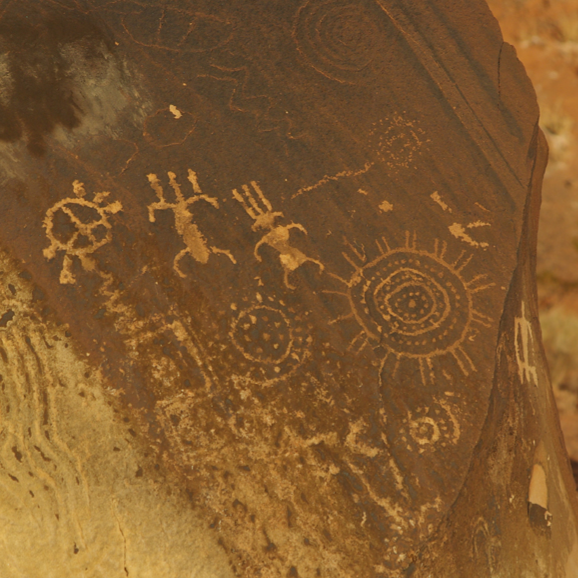
We used this lesson to have students do cave painting (the virtual tour of the caves of Lascaux is amazing and the story When Cave Men Paintedby Norman Bate is the perfect accompaniment), create their own pictograms, practice hieroglyphs, learn calligraphy, and design their own fonts. We also read How the First Letter Was Written from the Just-So Stories by Rudyard Kipling (free online).


It's a fun time to revisit and enjoy alphabet books (and a great tie-in with a first grade capital letters MLB if you are homeschooling different ages).


It's also a great time to introduce conventions of speech, like spelling and capitalization rules (another tie-in, if you are teaching a second grader as well).

Chalkboard Drawing in the Waldorf Classroom

Looking at what to do before starting my PhD in leadership and change...
a graduate certificate in Administration, a M.Ed. in Waldorf elementary education.

While looking at Antoich's wonderful Waldorf teacher training program, I found that they've posted some of their graduates' final projects. Check out this fantastic resource!

Chalkboard Drawing in the Waldorf Classroom (pdf)


Sunday, November 3, 2013

Black Walnut Ink

This is the time of year to collect black walnuts and make black walnut ink!

How to Make Black Walnut Ink

Wonderful for a language arts block that includes cutting quill pens and doing some handwriting practice.


Some books I just love for the story of written language (we teach this as a Great Lesson in Montessori so I have a TON of resources to suggest if you have any questions) are